
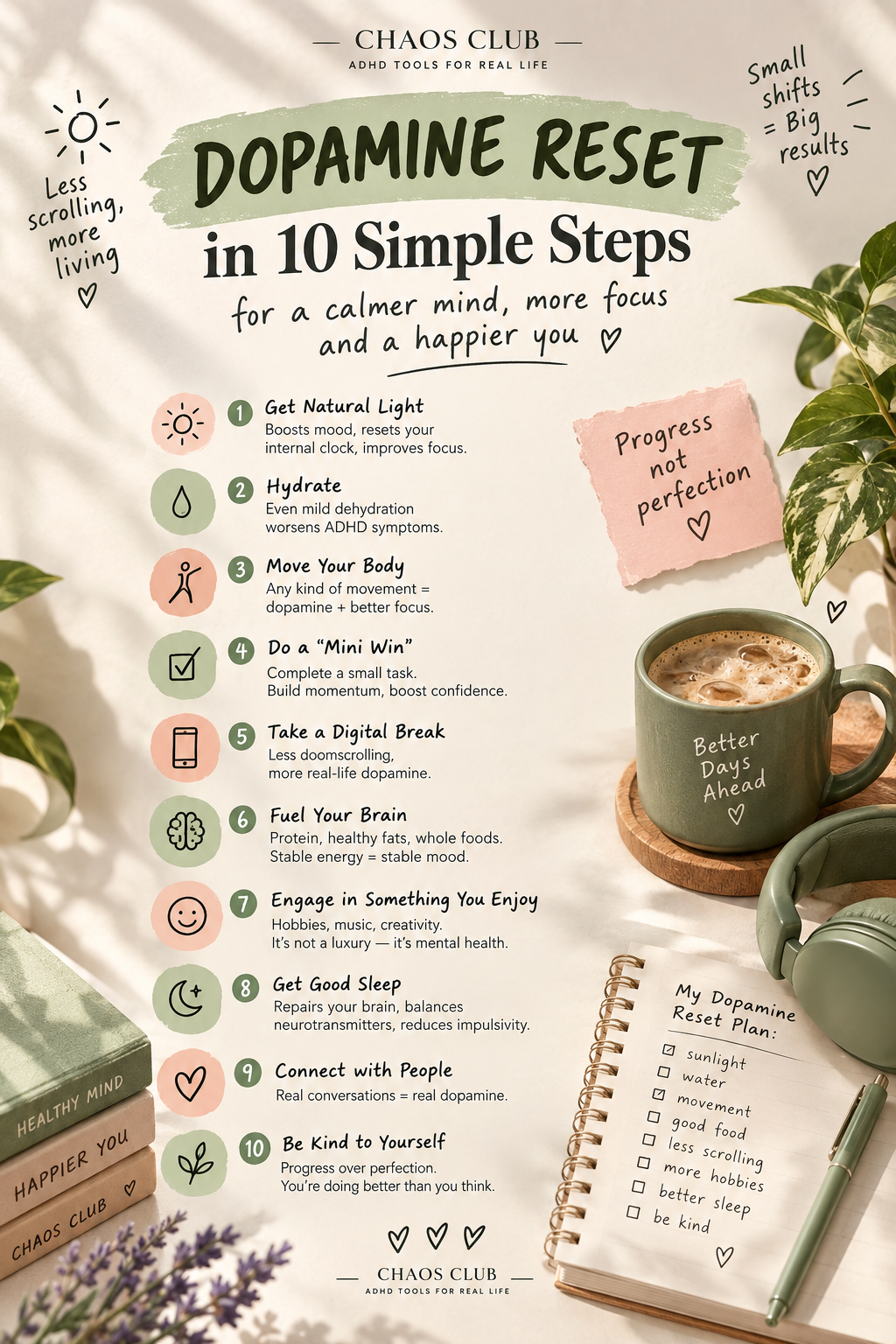
Feeling stuck, scattered, unmotivated, or glued to your phone? You may not need more discipline—you may need a smaller starting point. There are days when even the simplest task feels strangely difficult. You know you should answer that email. You know the laundry needs folding. You know you have work to do. But somehow, you’re scrolling. Then you scroll a little more. Then you feel guilty for scrolling. And now you’re overwhelmed and still haven’t started. If that sounds familiar, you’re not alone. For people with ADHD, getting started can sometimes be much harder than knowing what needs to be done. That’s where a simple dopamine reset routine can be useful—not as a magical “dopamine detox,” but as a collection of small behaviors that can help you shift your environment, wake up your body, reduce distractions, and make the next action easier. And the best part? You don’t have to do all 10. Pick one. First: What Does “Dopamine Reset” Actually Mean? Let’s clear up one thing. You cannot—and don’t need to—“reset” or detox your brain from dopamine. Dopamine is a neurotransmitter involved in motivation, learning, reward, movement, and many other brain functions. It isn’t simply the “pleasure chemical” that needs to be eliminated. When people talk about a dopamine reset, they usually mean taking a break from highly stimulating habits—such as endless scrolling, constant notifications, or rapid-fire entertainment—and deliberately making room for activities that support attention, movement, connection, and everyday rewards. For ADHD brains, this can be particularly interesting because starting and sustaining tasks can sometimes require more external structure and stimulation. So instead of trying to “get rid of dopamine,” think: Less mindless stimulation. More intentional stimulation. That’s a much more useful goal. 10 Simple Steps for an ADHD Dopamine Reset 1. Get Some Natural Light ☀️ Before reaching for your phone, try stepping outside or sitting somewhere with natural light. Morning light is an important cue for your body’s internal clock, and regular exposure to daylight can support healthy sleep-wake rhythms. And you don’t need to turn it into a complicated morning routine. Open the curtains. Stand on the balcony. Walk outside for five minutes. Drink your coffee by a window. Tiny action → environmental signal → easier transition into your day. 2. Hydrate 💧 Sometimes the first thing your brain needs isn’t another productivity hack. It’s water. Mild dehydration can affect how you feel and function, so keeping hydrated is a simple piece of basic self-care. If you frequently forget to drink water, make the habit ridiculously easy: Don’t rely entirely on remembering. Make the environment remember for you. 3. Move Your Body 🏃 You don’t need a perfect workout. You don’t need an hour at the gym. You don’t even need gym clothes. Try: Movement can influence mood, alertness, and executive functioning—and research has explored physical activity as a useful component of ADHD management. The trick? Make the starting point so small that your brain doesn’t have time to negotiate. “I’m going for a 10-minute walk” can feel like a task. “I’m putting my shoes on” feels much easier. Start there. 4. Get One Tiny Win ✅ This might be the most ADHD-friendly idea on the list. When everything feels overwhelming, don’t ask: “How do I finish everything?” Ask: “What is one thing I can finish in the next five minutes?” Put one plate away. Reply to one message. Throw away three pieces of trash. Open the document. Put your laundry in the basket. A completed action creates momentum. And momentum matters when you’re stuck. Try the “Mini Win” rule: Choose → Start → Finish → Stop. You don’t have to turn one tiny task into a three-hour productivity session. A win is still a win. 5. Take a Digital Break 📱 This one can be uncomfortable. Especially if your phone is your favorite source of instant stimulation. Endless scrolling gives your attention something new every few seconds. Switching back to a slower activity afterward can feel surprisingly difficult. Instead of declaring: “I’m never scrolling again.” Try: “I’m taking 20 minutes away from my phone.” Put it in another room. Turn off unnecessary notifications. Leave it in your bag while you walk. Eat without it. Work with it out of reach. You’re not banning technology. You’re creating a little friction between you and automatic scrolling. And sometimes, that’s enough. 6. Fuel Your Brain 🥑 Your brain needs energy. Instead of obsessing over the “perfect ADHD diet,” focus on consistent, balanced meals and snacks that work for your life. Think about including things such as: And if you’re someone who regularly forgets to eat because you’re hyperfocused? Make food easier to access. Keep simple options visible and ready. Because an ideal meal you never prepare is less useful than a simple meal you actually eat. Convenience is not laziness. It’s strategy. 7. Do Something You Actually Enjoy 🎧 This one often gets left off productivity lists. It shouldn’t. Your brain isn’t a machine that exists only to complete tasks. Listen to music. Draw. Read. Garden. Cook. Play a game. Take photographs. Build something. Spend time with a hobby. Laugh with a friend. Enjoyment isn’t something you have to “earn” after you’ve completed everything on your to-do list. Pleasure and play are part of being human. And when your entire day becomes work + chores + scrolling + guilt, your brain can start associating everyday life with obligation. Make room for things you genuinely like. 8. Protect Your Sleep 🌙 If your sleep is chaotic, everything else can feel harder. Sleep supports attention, memory, emotional regulation, and overall brain function. For people with ADHD, sleep problems can also overlap with or intensify difficulties with attention and executive functioning. You don’t need a flawless nighttime routine. Start with one anchor. For example: “My phone charges outside my bedroom.” Or: “I start winding down at the same time most nights.” Or: “I dim the lights 30 minutes before bed.” One consistent cue is better than an elaborate routine
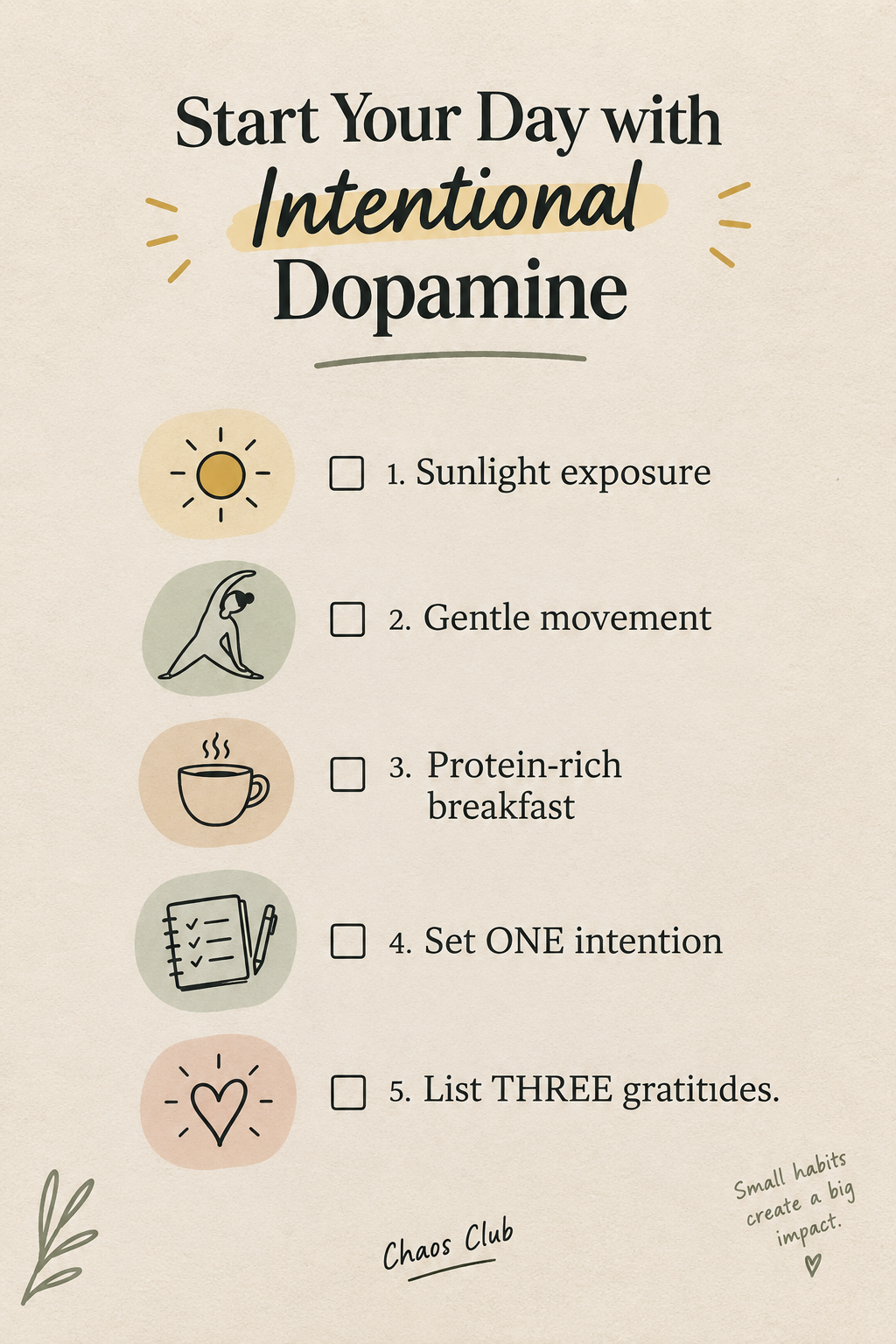
Start Your Day With Intentional Dopamine: 5 Simple Morning Habits for an ADHD-Friendly Start
What if your morning didn’t begin with notifications, endless scrolling, and the feeling that you’re already behind? For many people with ADHD, the first few minutes of the day can set the tone for everything that follows. You wake up. Reach for your phone. Check one notification. Then another. A quick scroll turns into twenty minutes, and suddenly your brain has consumed a huge amount of information before you’ve even gotten out of bed. Now you’re rushing. Your attention is scattered. And the day hasn’t even started. But here’s the good news: Your morning doesn’t have to be complicated to feel different. You don’t need a two-hour morning routine, a perfectly organized kitchen, or an impressive 5 AM schedule. Instead, you can create a few small intentional sources of stimulation and structure that help you transition into your day with more awareness. Think of it as intentional dopamine: choosing what you give your attention to instead of automatically handing it over to your phone. Here are five simple habits to try. What Is “Intentional Dopamine”? Let’s clear up the terminology first. Dopamine isn’t something you need to “detox” from or eliminate. It’s a neurotransmitter involved in motivation, learning, reward, movement, and many other brain processes. So when we talk about intentional dopamine, we’re not talking about manipulating your brain chemistry with a magic morning hack. We’re talking about something much simpler: Being intentional about the activities you use to start your day. Instead of beginning with whatever provides the fastest stimulation—notifications, social media, emails, or endless scrolling—you can deliberately introduce things like sunlight, movement, food, planning, and positive reflection. For an ADHD brain that tends to be drawn toward novelty and immediate rewards, creating this structure can make the transition into the day feel more manageable. 1. Get Some Sunlight ☀️ Before your phone becomes the main character of your morning, give your brain a chance to notice the outside world. Open the curtains. Stand near a bright window. Step outside with your coffee. Take a short walk. Morning light is an important environmental cue for your circadian rhythm—the internal system that helps regulate your sleep-wake cycle. Regular exposure to daylight, particularly earlier in the day, can help reinforce healthy timing for your body clock. And there’s another benefit: It gets you out of the bedroom-and-phone bubble. Instead of waking up and immediately consuming information, you’re giving yourself a physical transition between sleep and being awake. Try this: Don’t make “go outside for 30 minutes” the goal. Make it: “Open the curtains as soon as I get up.” If you naturally continue from there, great. If not, you’ve still completed the habit. 2. Add Gentle Movement 🧘 Your morning doesn’t need to begin with an intense workout. Especially if you’re already struggling to get started. Try something easy: Movement can support alertness and mood, and physical activity has been studied as one component of ADHD symptom management. But there’s an important ADHD-friendly principle here: Don’t make the habit harder than it needs to be. If “work out for an hour” makes you want to avoid the entire morning, lower the barrier. Two minutes counts. The goal isn’t to become a fitness influencer before breakfast. The goal is simply to tell your body: “We’re awake. Let’s get moving.” 3. Eat a Protein-Rich Breakfast 🍳 Food is another piece of the morning puzzle. A balanced breakfast that includes protein can be a practical way to make your first meal more filling and satisfying. Think simple: You don’t need a complicated “ADHD breakfast.” You need something that is realistic enough to actually eat. And that’s especially important if you tend to forget meals when you’re hyperfocused. Make breakfast ADHD-friendly: Keep easy foods visible. Prepare something the night before. Have two or three default breakfasts. Remove unnecessary decisions. Because at 8 AM, “What should I make for breakfast?” can become an entire executive-function project. Fewer decisions = easier starts. 4. Set ONE Intention 📝 Notice the word: ONE. Not fifteen goals. Not a 47-item productivity system. Not “completely transform my life today.” Just one intention. Ask yourself: “What matters most to me today?” Your answer could be: An intention is different from a giant to-do list. A to-do list tells you what you need to do. An intention reminds you how you want to move through the day. And sometimes that’s exactly what an overwhelmed brain needs. Try this: Write one sentence: “Today, I want to ______.” That’s it. 5. Write Down Three Things You’re Grateful For ❤️ This might sound simple—and that’s the point. Before your brain starts cataloging everything that’s wrong, unfinished, overdue, or stressful, pause and notice three things that are already okay. They can be incredibly small. “My coffee was good.” “I slept in a comfortable bed.” “My dog made me laugh.” “The sun is out.” “I have clean clothes.” “I’m getting another chance to try today.” Gratitude practices aren’t a cure for ADHD, and they shouldn’t be used to dismiss genuine problems. But intentionally noticing positive experiences can be a simple way to shift your attention toward something other than urgency and negativity. And it takes less than a minute. The ADHD-Friendly Morning Formula Put the five habits together and you get: ☀️ LIGHT Give your body a clear morning signal. 🧘 MOVEMENT Get your body involved before sitting down to work. 🍳 FOOD Give yourself something nourishing and satisfying. 📝 INTENTION Choose one thing that matters today. ❤️ GRATITUDE Notice three things that are already good. You could do all five in 10–20 minutes. Or you could spread them throughout your morning. There are no bonus points for doing everything perfectly. But What If You Wake Up and Immediately Grab Your Phone? First: Don’t turn that into a reason to give up. This is one of the biggest traps with habit-building. You scroll for 30 minutes and think: “Well, I already ruined my morning.” No. You haven’t ruined anything. Your morning isn’t a test you can fail.