Feeling stuck, scattered, unmotivated, or glued to your phone? You may not need more discipline—you may need a smaller starting point.
There are days when even the simplest task feels strangely difficult.
You know you should answer that email. You know the laundry needs folding. You know you have work to do.
But somehow, you’re scrolling.
Then you scroll a little more.
Then you feel guilty for scrolling.
And now you’re overwhelmed and still haven’t started.
If that sounds familiar, you’re not alone. For people with ADHD, getting started can sometimes be much harder than knowing what needs to be done.
That’s where a simple dopamine reset routine can be useful—not as a magical “dopamine detox,” but as a collection of small behaviors that can help you shift your environment, wake up your body, reduce distractions, and make the next action easier.
And the best part?
You don’t have to do all 10.
Pick one.
First: What Does “Dopamine Reset” Actually Mean?
Let’s clear up one thing.
You cannot—and don’t need to—“reset” or detox your brain from dopamine.
Dopamine is a neurotransmitter involved in motivation, learning, reward, movement, and many other brain functions. It isn’t simply the “pleasure chemical” that needs to be eliminated.
When people talk about a dopamine reset, they usually mean taking a break from highly stimulating habits—such as endless scrolling, constant notifications, or rapid-fire entertainment—and deliberately making room for activities that support attention, movement, connection, and everyday rewards.
For ADHD brains, this can be particularly interesting because starting and sustaining tasks can sometimes require more external structure and stimulation.
So instead of trying to “get rid of dopamine,” think:
Less mindless stimulation. More intentional stimulation.
That’s a much more useful goal.
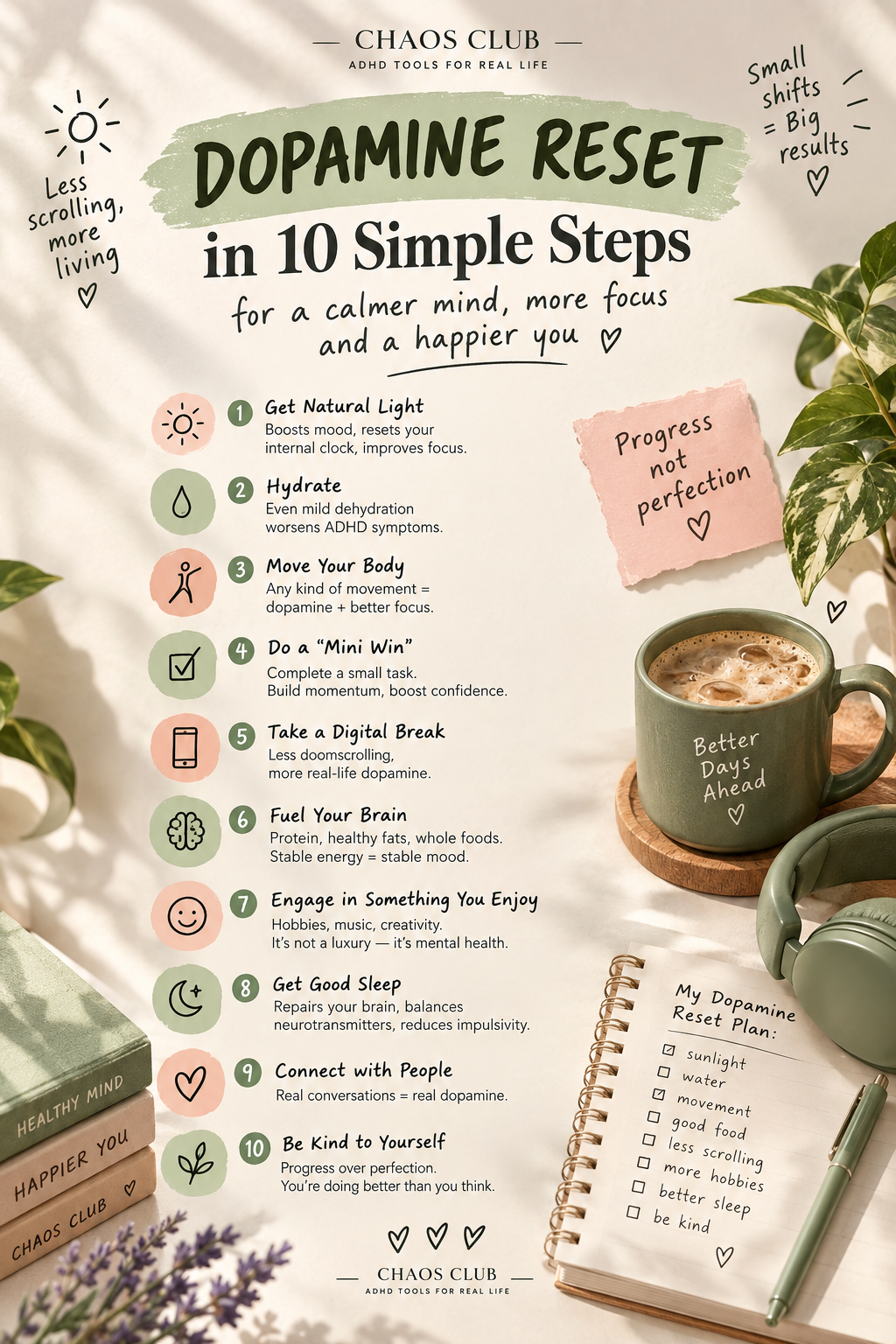
10 Simple Steps for an ADHD Dopamine Reset
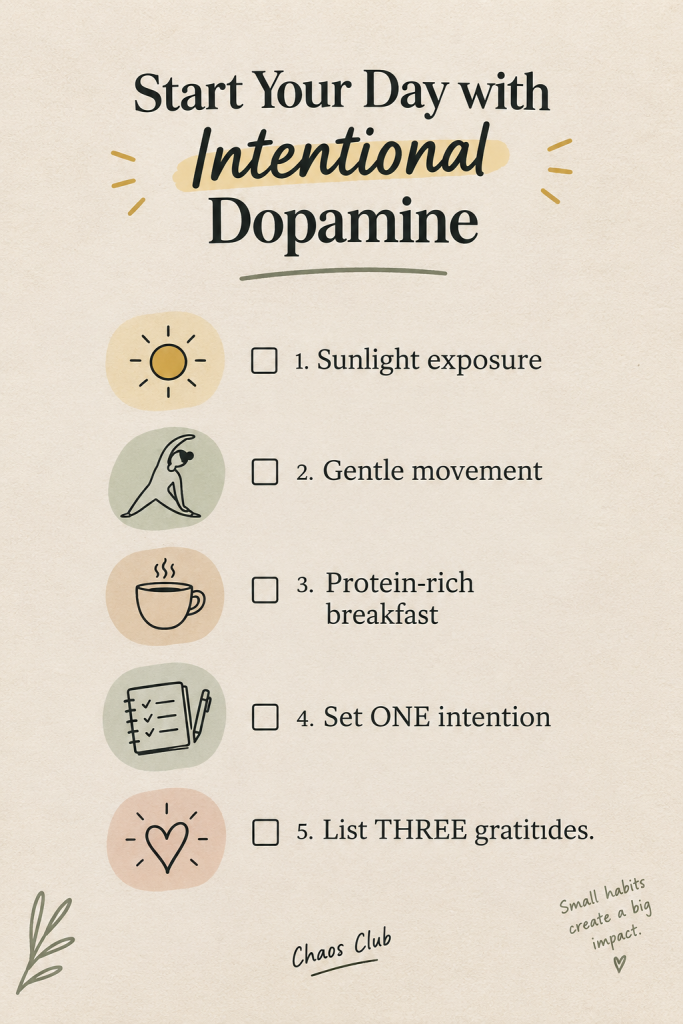
1. Get Some Natural Light ☀️
Before reaching for your phone, try stepping outside or sitting somewhere with natural light.
Morning light is an important cue for your body’s internal clock, and regular exposure to daylight can support healthy sleep-wake rhythms.
And you don’t need to turn it into a complicated morning routine.
Open the curtains.
Stand on the balcony.
Walk outside for five minutes.
Drink your coffee by a window.
Tiny action → environmental signal → easier transition into your day.
2. Hydrate 💧
Sometimes the first thing your brain needs isn’t another productivity hack.
It’s water.
Mild dehydration can affect how you feel and function, so keeping hydrated is a simple piece of basic self-care.
If you frequently forget to drink water, make the habit ridiculously easy:
- Keep a bottle on your desk.
- Put one beside your bed.
- Carry one when you leave the house.
- Pair drinking water with something you already do.
Don’t rely entirely on remembering.
Make the environment remember for you.
3. Move Your Body 🏃
You don’t need a perfect workout.
You don’t need an hour at the gym.
You don’t even need gym clothes.
Try:
- A 5-minute walk
- Stretching
- Dancing to one song
- Walking around the room
- A few squats
- Taking the stairs
- Doing some mobility exercises
Movement can influence mood, alertness, and executive functioning—and research has explored physical activity as a useful component of ADHD management.
The trick?
Make the starting point so small that your brain doesn’t have time to negotiate.
“I’m going for a 10-minute walk” can feel like a task.
“I’m putting my shoes on” feels much easier.
Start there.
4. Get One Tiny Win ✅
This might be the most ADHD-friendly idea on the list.
When everything feels overwhelming, don’t ask:
“How do I finish everything?”
Ask:
“What is one thing I can finish in the next five minutes?”
Put one plate away.
Reply to one message.
Throw away three pieces of trash.
Open the document.
Put your laundry in the basket.
A completed action creates momentum.
And momentum matters when you’re stuck.
Try the “Mini Win” rule:
Choose → Start → Finish → Stop.
You don’t have to turn one tiny task into a three-hour productivity session.
A win is still a win.
5. Take a Digital Break 📱
This one can be uncomfortable.
Especially if your phone is your favorite source of instant stimulation.
Endless scrolling gives your attention something new every few seconds. Switching back to a slower activity afterward can feel surprisingly difficult.
Instead of declaring:
“I’m never scrolling again.”
Try:
“I’m taking 20 minutes away from my phone.”
Put it in another room.
Turn off unnecessary notifications.
Leave it in your bag while you walk.
Eat without it.
Work with it out of reach.
You’re not banning technology.
You’re creating a little friction between you and automatic scrolling.
And sometimes, that’s enough.
6. Fuel Your Brain 🥑
Your brain needs energy.
Instead of obsessing over the “perfect ADHD diet,” focus on consistent, balanced meals and snacks that work for your life.
Think about including things such as:
- Protein
- Whole grains
- Fruits and vegetables
- Healthy fats
- Enough fluids
And if you’re someone who regularly forgets to eat because you’re hyperfocused?
Make food easier to access.
Keep simple options visible and ready.
Because an ideal meal you never prepare is less useful than a simple meal you actually eat.
Convenience is not laziness. It’s strategy.
7. Do Something You Actually Enjoy 🎧
This one often gets left off productivity lists.
It shouldn’t.
Your brain isn’t a machine that exists only to complete tasks.
Listen to music.
Draw.
Read.
Garden.
Cook.
Play a game.
Take photographs.
Build something.
Spend time with a hobby.
Laugh with a friend.
Enjoyment isn’t something you have to “earn” after you’ve completed everything on your to-do list.
Pleasure and play are part of being human.
And when your entire day becomes work + chores + scrolling + guilt, your brain can start associating everyday life with obligation.
Make room for things you genuinely like.
8. Protect Your Sleep 🌙
If your sleep is chaotic, everything else can feel harder.
Sleep supports attention, memory, emotional regulation, and overall brain function. For people with ADHD, sleep problems can also overlap with or intensify difficulties with attention and executive functioning.
You don’t need a flawless nighttime routine.
Start with one anchor.
For example:
“My phone charges outside my bedroom.”
Or:
“I start winding down at the same time most nights.”
Or:
“I dim the lights 30 minutes before bed.”
One consistent cue is better than an elaborate routine you abandon after three days.
9. Connect With Someone ❤️
When you’re overwhelmed, it’s easy to disappear into your own head.
Sometimes the best reset isn’t productivity.
It’s connection.
Text someone.
Call a friend.
Have coffee with someone.
Take a walk together.
Ask someone how they’re doing.
Humans are social creatures, and meaningful connection can support emotional wellbeing.
And for ADHD brains, body doubling can also be helpful for some people: simply having another person present while you work can make it easier to begin and stay engaged.
You don’t always need someone to solve the problem.
Sometimes you just need someone there.
10. Be Kind to Yourself 🌱
This might be the most important step.
Because there’s a difference between:
“I need to change this habit.”
and
“There’s something wrong with me because I have this habit.”
The first can lead to action.
The second usually leads to shame.
If you spent two hours scrolling instead of doing what you planned to do, beating yourself up won’t give you those two hours back.
Try:
“Okay. That happened. What’s the smallest useful thing I can do now?”
That’s the reset.
Not Monday.
Not tomorrow.
Not after you’ve become a perfectly organized person.
Now.
Your ADHD Dopamine Reset Doesn’t Need to Be Perfect
Here’s the trap with routines:
You create a beautiful 14-step morning routine.
You follow it for three days.
Then life happens.
You miss one morning.
Then two.
Then suddenly your brain decides:
“Well, I’ve ruined it.”
Nope.
You haven’t.
The goal isn’t perfection.
The goal is returning.
Think of these 10 ideas as a menu, not a checklist you have to complete every day.
On a good-energy day, maybe you do seven.
On a terrible day, maybe you drink some water and open the curtains.
That still counts.
The 2-Minute ADHD Reset
When your brain feels completely stuck, forget the entire list.
Try this:
☀️ Step 1: Change your environment
Stand up and move to another room or go outside.
💧 Step 2: Drink some water
No complicated wellness routine required.
🚶 Step 3: Move for two minutes
Walk, stretch, shake it out—anything.
📵 Step 4: Put your phone away
Even for 10 minutes.
✅ Step 5: Do one tiny thing
Something that can actually be finished.
That’s it.
You’re not trying to become productive.
You’re trying to create enough movement to make the next action possible.
Save This for Your Next ADHD Slump
You don’t need to overhaul your entire life to feel a little more grounded.
Sometimes the reset looks like:
☀️ Get some light
💧 Drink water
🚶 Move your body
✅ Get one tiny win
📵 Step away from scrolling
🥑 Eat something nourishing
🎧 Do something you enjoy
🌙 Protect your sleep
❤️ Connect with someone
🌱 Be kind to yourself
Small shifts can create big changes over time.
And if your brain is screaming for a complete life makeover today?
Give it something smaller.
One glass of water.
One song.
One walk around the room.
One tiny task.
Then see what happens next.
Your ADHD Reset Reminder
You don’t have to fix everything today.
You just need to make the next step a little easier.
Progress, not perfection. 🤍