
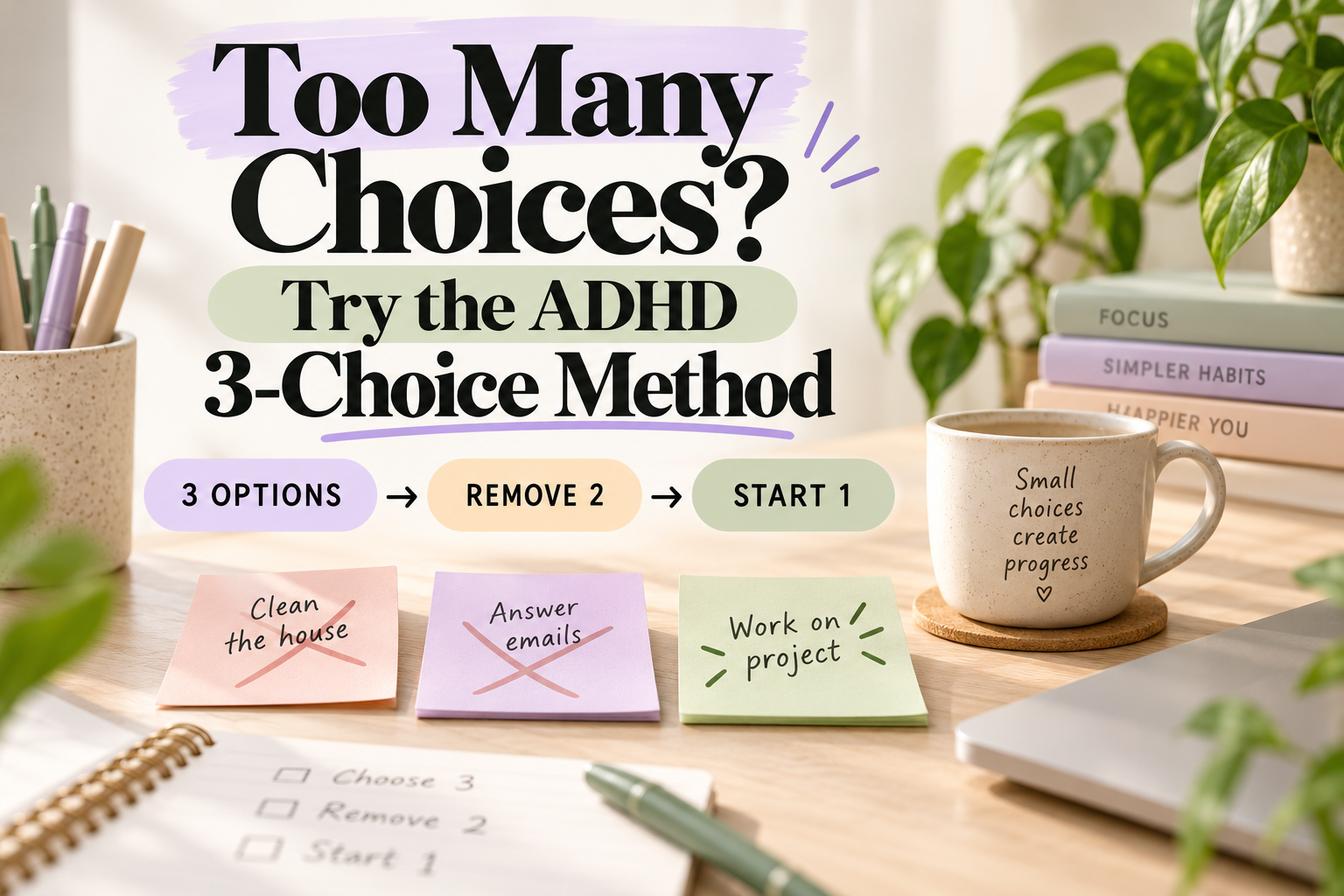
Too Many Choices? Try the 3-Choice Method.
Sometimes the task is not the hardest part. Choosing what to do first is.
When everything feels important, every option competes for attention, and even a simple decision starts to feel strangely heavy, adding more choices usually does not help. The goal is not to make the perfect decision. It is to make the next decision small enough to move.
Why can choosing feel harder than doing?
You open your task list and see twelve things. You know several of them matter. You also know you cannot realistically do all of them right now.
So your brain starts comparing:
Should I answer the email first?
Or clean the kitchen?
Maybe I should finish that project.
But I also need groceries.
What if I start the wrong thing?
Five minutes later, you may still be deciding.
Researchers have found that adults with ADHD can experience difficulties in several executive-function domains, including planning, working memory, inhibition, and decision making. That does not mean every difficult decision is caused by ADHD, or that everyone with ADHD experiences decision overload in the same way. But for some people, holding several competing options in mind while prioritizing and acting on one of them can create substantial friction.
This is where reducing the number of choices can help.
Decision fatigue is not the same thing as laziness.
A person can genuinely want to begin and still spend too much mental energy deciding where to begin.
More motivation is not always the missing ingredient. Sometimes the system simply presents too many possibilities at once.
The 3-Choice Method
Instead of asking your brain to choose from everything, temporarily reduce the decision to only three realistic options.
Pick only three options.
Ignore the full list for a moment. Choose three things that could reasonably happen next.
Remove two.
Ask which option is easiest to postpone, delegate, shrink, or simply leave alone for now.
Start one.
Do not optimize again. Begin the remaining choice with the smallest physical action.
The 3-Choice Method is a practical framework created by The Chaos Club. It is not a diagnostic or clinical treatment protocol.
When the whole house feels urgent.
Imagine looking around and noticing dishes, laundry, clutter, paperwork, recycling, an unmade bed, and a messy desk.
“Clean the house” contains too many hidden decisions.
Now remove two.
Maybe the dishwasher is easiest because it takes five minutes and immediately reduces visible clutter.
Your first action is no longer:
When your work list has too many priorities.
Suppose your list contains emails, a presentation, an expense form, research, a meeting, and three smaller admin tasks.
Instead of ranking all eight, create a temporary shortlist:
If the email can wait and the expense form is not due today, the presentation becomes the current choice.
Then reduce it again:
The method does not magically remove every difficult decision. It reduces the number of active decisions competing for attention.
When even choosing food feels exhausting.
Decision overload is not limited to work. It can appear in everyday choices such as what to eat.
Instead of opening every delivery app, searching recipes, checking the fridge repeatedly, and comparing dozens of options, reduce dinner to three categories:
On a depleted day, the goal does not have to be the most optimized choice. It can simply be a reasonable choice that ends the decision loop.
Use the Decision Filter.
Ask the same three questions instead of inventing new criteria every time.
What matters soonest?
Look for a real deadline or consequence, not just the task that feels loudest.
What unlocks something else?
Some actions make several later actions easier. Those often deserve priority.
What fits my current energy?
A theoretically perfect choice is not useful if you cannot realistically begin it right now.
Some days, even three choices are too many.
On very low-energy days, shrink the method again.
“Prepare without doing” can mean opening the document, placing the laundry basket by the washer, filling a bottle of water, or putting the materials you need on the desk.
Progress can sometimes mean making the next attempt easier.
What makes decision overload worse?
Rewriting the whole list.
A prettier list can still contain exactly the same number of decisions.
Researching every option.
More information can become another way of delaying the decision.
Waiting for certainty.
Many ordinary decisions do not have one objectively perfect answer.
Reopening the decision.
Once you choose, give the choice a short protected window before reconsidering it.
A 60-second decision reset.
Step 1: Write down the three things most likely to happen next.
Step 2: Cross out the easiest one to postpone.
Step 3: Cross out the second one.
Step 4: Turn the remaining choice into one physical first action.
More ADHD-friendly tools from The Chaos Club
When your brain feels overloaded
Use a simple reset to clear the noise and find one manageable next step.
START THE RESET → DOPAMINE MENUWhen motivation feels unavailable
Build a menu of stimulation options around the energy you actually have.
BUILD YOUR MENU → ADHD TOOLSWhen you need a different tool
Browse practical supports for starting, focusing, resetting, and organizing.
EXPLORE THE TOOLS →ADHD decision fatigue FAQ
Is decision fatigue an ADHD symptom?
“Decision fatigue” is not a diagnostic criterion for ADHD. However, some adults with ADHD experience difficulties involving executive functions such as working memory, planning, inhibition, prioritization, and decision making. Those difficulties can make situations with many competing choices feel especially demanding.
What if I choose the wrong task?
For ordinary low-risk decisions, a reasonable imperfect choice is often more useful than staying stuck while searching for the perfect choice. High-stakes financial, medical, legal, or safety decisions deserve more deliberate evaluation and appropriate professional guidance.
Does the 3-Choice Method work for everyone with ADHD?
No tool works for everyone. The method is designed as a simple way to reduce the number of active choices. Adapt it, reduce it to two choices, or use a different support if another approach works better for you.
Can I use this with a to-do list?
Yes. Keep the full list somewhere external, but temporarily select only three candidates for the next action. The full list remains available without forcing you to evaluate every item each time you need to begin.
Still too overwhelmed to choose?
The free ADHD Reset Kit includes five practical tools for stuck, scattered, overloaded, and low-energy days.
GET THE FREE ADHD RESET KIT →✓ 5-Minute ADHD Reset
✓ Brain Dump Sheet
✓ Dopamine Menu
✓ Low-Energy Day Plan
✓ Can’t Start Checklist
Written by The Chaos Club Editorial Team
The Chaos Club creates practical, low-pressure tools for ADHD-friendly productivity, executive-function challenges, organization, dopamine, and everyday resets. Our goal is to turn useful concepts into clear, adaptable resources designed for real-life messy days.
Published: October 21, 2026
This article is for general educational and informational purposes only. It does not provide medical advice, diagnosis, or treatment and is not a substitute for individualized guidance from a qualified healthcare professional.
Sources & further reading
CHADD — Executive Function Skills.
Boonstra et al. — Executive functioning in adult ADHD: a meta-analytic review. Psychological Medicine.
Mowinckel et al. — A meta-analysis of decision-making and attention in adults with ADHD.
Alderson et al. — ADHD and working memory in adults: a meta-analytic review. Neuropsychology.